
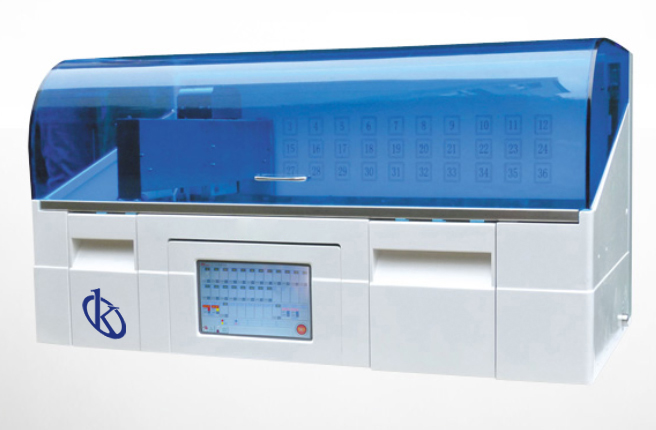
Within the realm of histology and laboratory applications, having a reliable and efficient slide stainer is essential for accurate diagnostic work. Two prominent products in this field are the Automatic Slide Staining YR435-1 by Kalstein and the Leica ST5010 Autostainer XL by Leica Microsystems. Both instruments offer advanced features for automatic slide staining, yet differ in design and capabilities that cater to specific research and clinical needs.
The Automatic Slide Staining YR435-1 from Kalstein stands out with a sleek design and cutting-edge technology aimed at laboratories seeking precision and automation in staining processes. The system is crafted to handle high volumes of slides with unmatched accuracy and consistency. Meanwhile, Leica’s ST5010 Autostainer XL offers a robust and flexible staining experience, aimed at laboratories that prioritize versatility and customization in their staining workflows. This comparison will delve into the specifications, operational functions, and market positioning of these two products to determine how each could best fit into a lab’s operational repertoire.
| Feature | Kalstein YR435-1 | Leica ST5010 Autostainer XL |
|---|---|---|
| Capacity | 40 slides per batch | Up to 11 racks with 30 slides each |
| Programs | Customizable staining protocols | Advanced programming options |
| User Interface | Touchscreen LCD | Ergonomic control panel |
| Dimensions | Compact design | Larger unit |
| Price | Competitive pricing | Premium pricing |
How They Work
The Kalstein Automatic Slide Staining YR435-1 operates with advanced robotics and programming to manage the delicate process of slide staining, ensuring precision with each batch. With its customizable protocols, users have the flexibility to adapt the machine to specific staining needs, optimizing throughput while maintaining accuracy.
On the other hand, the Leica ST5010 Autostainer XL embodies versatility in its operation. Equipped with extensive programming capabilities, it takes control of both routine and specialized staining procedures while offering integrated quality control features to assess each batch’s outcome.
What They’re Used For
Both the Kalstein YR435-1 and the Leica ST5010 are indispensable in pathology laboratories for the staining of histological slides. The stained slides are crucial for microscopic examination and diagnosis, providing vital insights into tissue structure and pathology.
These devices automate traditional staining methods, enhancing laboratory efficiency and accuracy, which are critical in clinical diagnostics and research environments.
Types
The Kalstein YR435-1 belongs to a category of compact, automated stainers that prioritize ease of use and reliability. Their design aims at enabling seamless integration into diverse laboratory setups, supporting a plethora of staining protocols required in modern diagnostic pathology.
In contrast, the Leica ST5010 is part of a more extensive system of autostainers. Designed for high-volume labs, they offer flexibility in batch processing and are optimized for diverse application needs through modular options and extensive programming flexibility.
Market Price
In terms of market price, the Automatic Slide Staining YR435-1 by Kalstein offers competitive pricing, making it accessible to a broader range of laboratories seeking state-of-the-art technology without a hefty investment. Typically, these units are priced lower compared to more established high-end brands yet deliver comparable performance.
Conversely, the Leica ST5010 Autostainer XL is positioned at the premium end of the market. Its sophisticated build and feature-rich offering justify a higher price point, appealing to large-scale labs looking for extensive performance and versatility in their staining operations.
Frequently Asked Questions
What is the capacity of the Kalstein YR435-1?
The YR435-1 is designed to handle 40 slides per batch, offering efficiency for medium-sized laboratories.
Can the staining protocols be customized in these machines?
Yes, both the Kalstein YR435-1 and Leica ST5010 allow for customizable staining protocols to suit various laboratory needs.
What kind of maintenance is required for these devices?
Regular maintenance, such as cleaning of the robotic arms and software updates, is crucial to ensure optimal performance of both machines.
Advantages and Disadvantages
Kalstein YR435-1 Advantages: This device boasts intuitive operation due to its LCD touchscreen and compact design, allowing seamless integration into various laboratory settings. The ease of protocol customization and its competitive pricing are significant advantages, giving it a leading edge for laboratories with restricted budgets.
Kalstein YR435-1 Disadvantages: While the YR435-1 delivers impressive performance, its capacity is slightly lower compared to some high-end competitors, which might be a limitation for extremely high-volume workflows.
Leica ST5010 Advantages: Offering extensive programming options and a higher slide capacity, the ST5010 is ideal for large operations that need robust and flexible staining solutions, even for the most demanding of protocols.
Leica ST5010 Disadvantages: Its larger footprint and higher cost may be prohibitive for smaller labs or those with limited space and funding.
Product Use in the Field
The Kalstein YR435-1 excels in settings requiring precision and speed, where reduced error rates in staining processes are pivotal. It is typically used in clinical settings for routine lab processes, offering unmatched accuracy necessary for timely and reliable diagnostics.
The Leica ST5010, with its extensive programming capacity, finds its place in high-throughput environments focused on complex diagnostic tasks. It’s particularly useful in research institutions and large hospitals where diverse and high-volume staining needs are common.
Recommendations
To maximize the efficacy of the Kalstein YR435-1, regular calibration and software updates are recommended to keep the machine operating at peak performance. It is also advisable to provide comprehensive training to lab technicians to fully exploit its automation capabilities.
For the Leica ST5010, it’s beneficial to maintain a regular maintenance schedule to ensure that its advanced features continue to deliver reliable results. User training to navigate its comprehensive programming options can enhance workflow efficiency.
If you are seeking a fusion of innovation and quality, you’ve come to the right place. At Kalstein we offer you the luxury to explore our exclusive catalog of laboratory equipment. We manufacture each device with a level of excellence. Our intuitive and agile online shopping channels are designed for your convenience, ensuring the most friendly prices. Don’t hesitate any longer, we bring science to life; it’s time to become part of our community. https://kalstein.pt/product/automatic-slide-staining-yr435-1/.